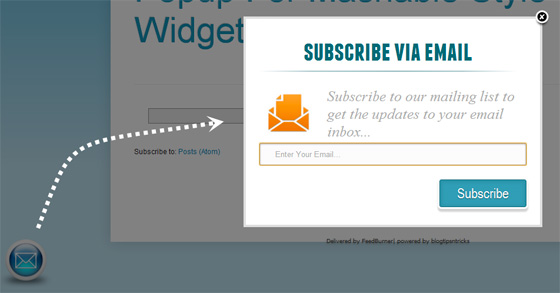
Are Email Subscription Pop-ups Worth The Risk?

email subscription popup

Note from Oli: It’s controversy time. Read the post and let’s get a good argument going in the comments. You know you want to.

Pop-ups are irritating at the best of times, and the majority of people don’t enjoy them. Even I am guilty of being a hater. This was until I saw some trusted blogs and bloggers using them and I couldn’t help but wonder why they were using pop-ups. And more importantly how successful they were.

Turns out, pop-ups actually have some impressive results so I decided to give them a chance. (Editor’s note: Peace got a chance, so why not pop-ups, right?)

The results shocked me…

The Power of Pop-Ups

Pop-ups are probably one of the best ways to increase your email subscribers. And fast.

The following image shows the results of my current pop-up:

Pop-up conversion rate

It converted 14.47% of the people who reached my blog.

The Downside of Pop-Ups

Pop-ups are powerful tools, but they’re a double-edged sword. Before you decide if pop-ups are right for you, consider the following:

1. Pop-ups are annoying

As I said before, people generally hate pop-ups. But you can bypass this problem by using the right techniques.

There are some pop-ups that have options allowing you to choose when they are shown on your page.

For example, I chose to show my pop-up to each person only once in 30 days – this allowed me to increase my email subscribers and not disturb my readers on a consistent basis.

2. Email subscribers via pop-ups have lower engagement

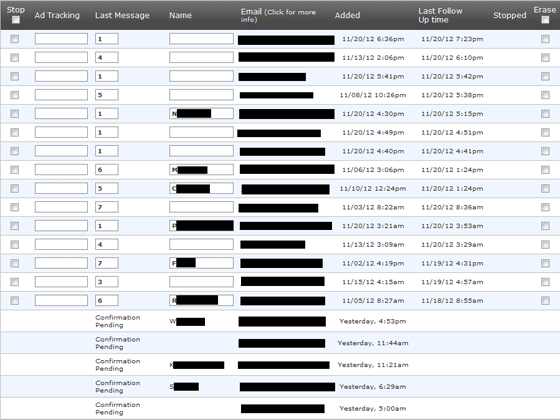
Sad but true: I found that people who subscribe via pop-ups aren’t as engaged as those who subscribe from a form on your website or landing page.

Here you can see an example:
Email subscribers by pop-up
This screenshot, shows all of the people who signed up via a pop-up. Notice the bottom group who haven’t confirmed their subscription.

3. Bad use of a pop-up can damage your brand

If your pop-up appears too often, people will start to have a negative perception of your brand. Throwing interruption marketing in your face all the time, is likely to make them devalue the purpose of your site, and that it’s all about list building.

Takeaway: Use a well filtered pop-up – or don’t use a pop-up at all.

How to Optimize Your Email Subscription Pop-Ups

Now that you know what you can expect from pop-ups, let’s talk about the practical aspects: pop-up optimization.

If you don’t optimize your pop-ups you’ll get poor results.

There are some general rules when it comes to optimization, but to get outstanding results, you need to test to find the threshold of your visitors.

1. Timing

Timing your pop-up is the most crucial aspect to get the results you want. The best time to show a pop-up is 60 seconds after your visitors enter your site.

If you time your pop-up before 60 seconds, there will be a significant drop off in conversion rates. However, if you wait too long, your pop-up will miss a large number of visitors.

2. Page views

It’s obvious: if a person reads more pages on your blog, they are more likely to subscribe.

If you decide to show your pop-up after your first page view, you’ll increase your conversion rate, but you’ll receive fewer impressions.

A pop-up that appears after 4 page views gets fewer impressions than a pop-up that shows after 2 page views.

Notice that some visitors will open multiple pages within a few seconds upon their arrival (in order to verify if they found what they’re searching or not). Keep both page views and time as filters: in this way only people who read your content will see your pop-ups.

3. Show your pop-up at the end of posts

People who read your post(s) from start to finish are usually engaged by your content. You can take that chance to get email subscribers.

The conversion rate that you’ll get using this strategy depends on your post quality. If your posts are brilliant, your conversion rate will be quite high.

Personally, I don’t use this strategy because I already have an opt in form at the end of my post. If you don’t have an opt in form, use a pop-up.

4. Headline

Like landing pages, your pop-up needs a powerful headline to make people provide their emails.

Your headline must grab the attention of your visitors.

Use your headline to make an offer that your visitors can’t refuse. And remember to test them to see which gather more subscribers.

5. Benefits

You have very little time to communicate to your visitors, and on a pop-up you also have limited space to get your message across. With this in mind, write them as succinctly as possible so they are easy to skim.

Don’ts of Pop-Ups

All the previous stuff doesn’t work if you ignore the following don’ts.

1. Don’t show your pop-up too often

If you show your pop-up too often you will be perceived as spammy, and people will leave. I suggest that you show your pop-up at maximum once per week – and preferably only once in 15-30 days.

2. Don’t try to keep people on your site

You’ve no doubt encountered those nasty pop-ups that don’t allow you to get away from a page. Don’t ever use them, as people will never come back.

3. Don’t ask for too much information

Pop-ups work like opt-in forms: if you ask for too much information your conversion rate will decrease.

Ask for name and email – or even just the email.


Pop-ups are great to increase your email subscribers, but you have to use them well to avoid the negative impacts. Remember that to get interesting results you have to test and optimize them.

The use of pop-ups is an extremely controversial topic. So let’s hear your opinion in the comments. What do you think about them? Have you ever used pop-ups?

– Mauro D’Andrea


About The Author

Photo of Mauro D Andrea

Mauro D'Andrea is the founder of Blog Growth, a blog that helps people reach their internet marketing goals. If you want to sell more and grow your income, take Mauro free guide “Increase Your Conversions”.
» More blog posts by

Comments

  1. Martin says:

    I’ve taken quite a hard public stance on them in the past, but it’s interesting to see some creative ways of reducing some of the negative impact while retaining their effectiveness – particularly the 60 second window.

    I’d encourage you to post a rebuttal purely from a UX/CRO point of view with some of the above in mind:

    http://www.quora.com/Search-Engine-Optimization-SEO/Are-dismissible-modal-dialogues-bad-for-SEO

  2. Alex Kay says:

    As you say, it’s all about keeping it classy, easy and relevant.

    Classy is handled by only showing it once every 30 days and only after 60 seconds. Easy is by asking only for the email. And relevant is by giving them something of real value – in my case a content-filled email course. As well as only showing it posts in the relevant categories.

    Thanks for the insights!

  3. Mauro, the success of pop-ups also depend a lot on which geography you are using them. For example, in India, we see a fairly high success rate with pop-ups (so much so, that we are even running ad campaigns with pop-ups … with a landing page conversion rate of 45%).

    However, in the more developed nations (US, Canada), they do not work all that well. Some of the top folks in education (the industry in which we are in) are also using pop-ups (HBR).

    • Prasad, you are right.
      The success of pop-ups depends on your market generally speaking, not only on the geography.

      For example, there are niches in which the blogs are satured with pop-ups, so they don’t convert really well.
      The key is to see if it work in your specific case, as with everything.

      Thanks for sharing your experience! By the way, a 45% conversion rate with a pop-up is huge, congratulations!

  4. Daniil says:

    Why does the author’s userpic in the black frame? Is everything ok with him?

  5. Claudiu says:

    Timing and context is everything and I have lots of data inside PadiAct to prove the point.

    Subscription rates are up to 20% when the targeting is done right and when the message rings a bell to our customers.

    The best usage I see from our customers: multiple campaigns with different messages based on the targeting (e.g organic traffic, targeted after 5 products viewed on the website with specific message based on the category of the visited products)

    Pop-ups are not the controversy but the way how they are posted without considering UX is.

  6. Phil Bowyer says:

    The biggest thing that popped out me is:

    “Email subscribers via pop-ups have lower engagement”

    Marketers spend too much time on numbers – or the wrong kind of numbers. I call them danger numbers. The goal is always 100,000 member list or whatever, but I rarely hear people talk about an engaged list. It’s not the size of your list, it’s what your list does that matters.

    So what if the conversion rate for pop ups is high (30-40%) if those people don’t ever engage with you. What’s the point?

    I treat people like how I want to be treated. If a pop-up interrupts me a minute into reading a post, I click back and never go back. It tells me all you want is my email.

    I’ll take a lower conversion and a smaller (yet engaged) list over a bloated list full of people who could care less about what I have to say.

    • Phil, you are right: numbers are not everything.

      But, the fact is that “Email subscribers via pop-ups have lower engagement” means that someone will be engaged – the engagement is lower, but it’s not zero.

  7. Great stuff! I have this conversation with clietns about 4-5 times a month but this post/break down is excellent! One thing I wanted to comment on tho… You say “The best time to show a pop-up is 60 seconds after your visitors enter your site.”

    But any sites analytics will tell you at what time the visitor is likeky to bounce or exit.

    SO I usually suggest looking at the page you want to put the popup on and THEN look at the metrics for that page and let the Bounce/Exit times tell you when to display it.

    So if the visitors are typically leaving at 45 seconds – launch the popup and 35 or 40 seconds.

    Make sense?

    Thanks and keep doing good things!

    PS- If you ever want/need any guest posts let me know.

    • Hi Dustin, I didn’t try that strategy because I realized that people who bounce from your blog are not interested at all, and a pop-up won’t change the fact.

      Maybe they could be interested in the future, but if you scare them with a pop-up, probably they won’t come back ever.
      Anyway, this is just a supposition – I didn’t try this idea.
      Maybe I can give it a try as soon as I have some free time.

      You are welcome.

      PS: that’s really kind of you. I’ll keep it in mind, thank you!

  8. Sarah Arrow says:

    I have found that if what you promise with your pop-up is poor quality, that if your autoresponder is below par then yes your list via pop-up or sidebar will be poor quality. I have built a strong and reactive list using pop-ups and I make a point of nurturing my list. I think too many people think the pop-up will do all the work when in fact it’s just the beginning of the work.

    • Of course, Sara, you are right: you have to do your part.

      Anyway, I didn’t say that the subscribers via pop-ups are poor quality, I said that the engagement is lower than the one from people subscribed via optin form.

      Thanks for sharing your experience!

  9. Peep says:

    People complaining about popups is no reason for not using them. They work very well. People complain about Walmart too, but they’re making $$$.

    Not showing the popup all the time and to all the people is the key here.

    Dan Zarella’s research (he says yes to popups): http://danzarrella.com/my-data-shows-email-popups-work-and-dont-hurt.html

    For me personally popups worked much better than no popups, but scroll triggered boxes work double as good.

    • Peep, thank you very much for sharing that: it’s a really interesting study!

      Well, the scroll triggered boxes are interesting alternatives to pop-ups. I already programmed to test them.

  10. Sean Work says:

    Yeah I hate em too. But you have to try them out at some point because they can work. Very well in some instances…

    Oh – and – peace never got a chance :(

    • Hi Sean, it’s a pleasure to see you here!

      Exactly! You can hate them, but when you hear many people who are saying good things about them, you start wondering what’s the truth. And you finish writing a post about how great they are :)

  11. Is there a WordPress plugin that does an email list signup light box that is customizable, in terms of who / how often / when the light box pops up?
    Would be awesome!

  12. Tom Bowen says:

    One key metric to look at after implementing a pop-up is your site’s bounce rate. However, if the modal doesn’t pop up until after 60 seconds, it’s unlikely that people who leave the site immediately thereafter would be recorded as bounces anyway (since they were already there for 60 seconds).

    Interestingly, at the Florida Conversion Conference, a couple speakers said they tried pop-ups for emails and experienced almost no negative effect on bounce rate. That would seem to me to be the key metric to analyze whether the pop-up is turning too many people off or not.

    • Hi Tom, I confirm that I didn’t see any effect on the bounce rate.
      It seems like pop-ups are becoming invisible as they are becoming more popular. After all, people just need to click “X” to close a pop-up if they don’t like it.

  13. Another good read, thanks for sharing this. I’ve always wondered the benefit of using pop-ups since I almost always get annoyed whenever I encountered one. I’m glad to have read this information.

  14. I freakin’ love this. Every time an expert (not you) tells me that something (popup) is a bad idea, I review in detail. I’ve loved popups for the longest time for my sites. At the end of the day what matters is how many people are on your list, and how many whip out their wallet. If popups increase that then people should get on them ASAP.

    • Hi Patrick, I believe that you should always analyze the reality from every angle, and you have to expose it to other people so they can choose with a full perspective.

      Thanks for your comment!

  15. There are several kinds of pop-ups pop-ins slide ins etc. Claudiu from PadiAct describes worst to best (and why we remember the worst) here: http://www.emailaudience.com/email-pop-ups-from-worst-to-best

  16. Tania Belkin says:

    Mauro,
    Brilliant post, thank you. I am a little hesitant to use pop ups, but you covered all the good points well. And it is true, nothing makes you want to leave a site faster than annoying pop ups :)

  17. Benjamin says:

    Great post ! Indeed pop-up works. And they work very well, if you use them wisely. See how Zalando, Shoptiques, and other great leaders use them to welcome visitors. http://wisepops.wordpress.com/2012/12/19/shoptiques-loves-pop-ups/ They surely would not use pop-ups if results were not excellent. As to me, I have tested on on my previous e-commerce website. It was displayed to first visitors, immediately. We had 2,5x more sign ups every day. And those emails were as qualified as others. So I guess there is no rules about this.

  18. Can anyone recommend some good plugins for WordPress? I would love to give it a go on my blog.

  19. [...] ads annoy people. In some rare cases they offer something worth the roadblock, but usually they disrupt the user [...]

  20. [...] ads annoy people. In some rare cases they offer something worth the roadblock, but usually they disrupt the user [...]

  21. [...] ads annoy people. In some rare cases they offer something worth the roadblock, but usually they disrupt the user [...]

  22. [...] ads provoke people. In some rare cases they offer something value a roadblock, though customarily they interrupt a user [...]

  23. [...] Are Email Subscription Pop-ups Worth The Risk? by Mauro D’Andrea. Undecided about using email pop-ups? Good stats plus dos and don’ts of using email pop-ups [...]

  24. [...] Popups can be used in a far less annoying way, such as only showing it when a visitor is on a page that shows they are engaged (About page) or have spent a considerable amount of time on your website.  I don’t like them personally, but if you do use them, use them in a way that doesn’t annoy people.  Check out this article on how to use popups responsibly. [...]

Leave a Reply

Segment Pixel