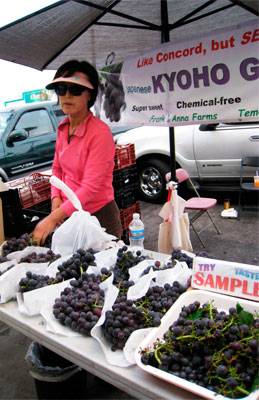
If you’ve ever shopped for fruit, then you’ve either “done it” … “thought about doing it” … or “watched someone else doing it”.
I’m talking about grape theft, an epidemic that impacts every supermarket from Vancouver to Sydney. But is it good, bad, right or wrong? And what does it have to do with form conversions? Quite a lot actually.

The grape seller in this photo has a 'sample tray'. This is smart for two reasons: it shows they believe in their product quality and it keeps grubby paws off the items for sale. (Or is the lady in the photo a grape thief?) - source
Shoppers, whether online or in the brick-and-mortar world, are an untrusting bunch (grape pun intended) who prefer to check out the goods before they’ll loosen their purse strings.
Shoppers want proof, and proof equals trust, which leads to purchases.
This parallel extends to the conversion psychology of visitors to your lead capture landing pages. Asking for an email address is a significant trust barrier, and to boost conversion rates you should be willing to offer a free sample of your wares in advance (e.g. a chapter of your report or whitepaper).
Only then should you ask for the key to their inbox.
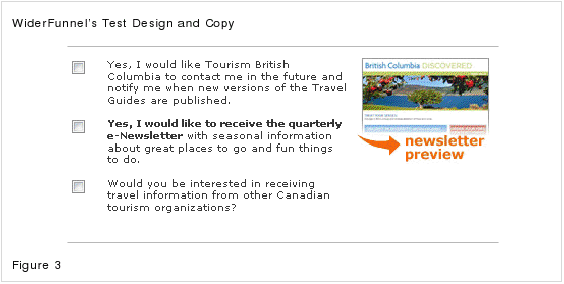
In a case study later on, we’ll see how providing a preview (in this case, a sample newsletter) helped to lift the conversion rate by 12%.
Before we examine the case study, let’s dig into the psychology to understand why having a preview is valuable to your visitors.
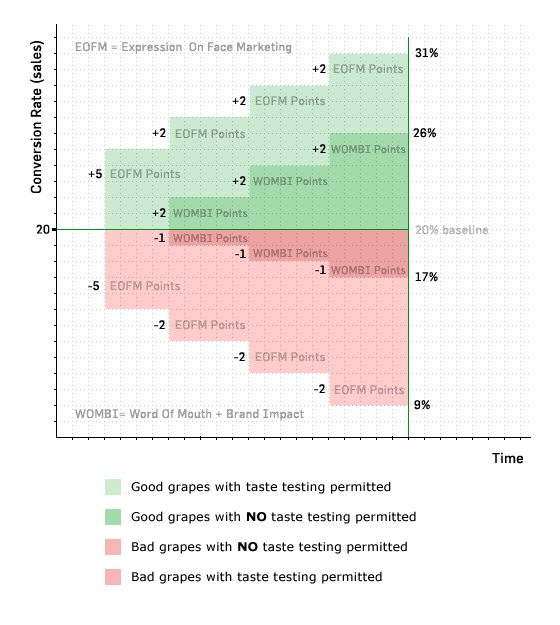
Note: All numbers are for illustration purposes only.
To summarize: Only charlatans peddling poor quality goods need to hide from the grape thief. If your digital grapes (eBooks and whitepapers) are top notch, let people try them before they buy them.
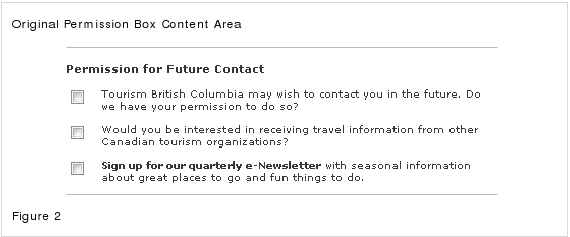
Conversion optimization specialists Wider Funnel ran a landing page optimization experiment for Tourism British Columbia which increased opt-in conversions for their newsletter by 12%. The test made modifications to the opt-in language and offered a preview of the newsletter that people would receive – enabling them to enter the try-before-you-buy mode which built up the trust and desire required to improve the opt-in rate.
There’s no point in getting someone to download your report if they don’t read it. This leads to a common occurrence known as “download now – read later syndrome”. In reality most documents won’t get read later – despite the best intentions – as people get caught up in their regular day-to-day work.
By including your best material in the preview – even if they don’t read the rest – they still know it contains value, making them more likely to read the rest later on AND respond in a positive manner to your follow up marketing.
Remember, if that first grape tasted great, you’ll be reaching for the fruit bowl later on and will buy more the next time you’re at the supermarket.
A monkey, some grapes and a video camera. What more do I need to say…
Run an A/B test with and without a document preview, then come back and share your results in the comments below. If they’re good, I’ll include them in a future case study. Which I’ll make you download by completing a form… after I let you eat a grape of course.
Hey Oli,
You overlooked the psychological principle of reciprocity. People buy grapes because they want to repay the generosity you offered. It’s the first principle of persuasion discussed on Cialdini’s wikipedia page http://en.wikipedia.org/wiki/Robert_Cialdini
Yes – “you get what you give”. Offering a preview will increase the likelihood of someone giving back to you in the form of an email. Which brings up an interesting question in terms of what constitutes a balanced reciprocal exchange.
Clearly I don’t want a preview of your report in exchange for mine (although that would be an interesting sharing device) – I want an email. So there needs to be a psychological scale along which one measures the “worth” of the perceived prize vs. the cost to acquire it.
And by adding the preview you essentially tip the scale in your favour.
Related psychological tactics here:
* free samples attract crowds, so there is an implicit word of mouth benefit to great grapes with sampling.
* online, great landing pages need some social proof. You want me to download this whitepaper, shouldn’t you show me reviews from others like me?
Great post Oli, when does #2 arrive?
This is actually kind of funny because I’ve been buying grapes regularly, and I always want to sneak a taste of them but never do. Mostly because it creeps me out that someone might have grabbed a grape from the bag I’m buying.
It is a good point thought – if you let people sample your product first (and you make sure that sample is awesome) then they’re more likely to dive in and buy it vs. being hesitant about the quality before purchasing. I should probably offer a free grape of my eBook on that note. :)
Yeah, that’s why the example in the photo is so brilliant (them, not me). The stall owner clearly gets the benefit of the “free sample” (preview) – but puts them in a separate basket so as to avoid the grubby fingers contaminating the rest of the grapes.
@Kristi – I’m like you, I’ve gotta wash those grapes before they hit my tongue. I’ve witnessed fruit processing, too. So, I would never recommend eating fruit that you do not peal without first washing it.
On another note, Oli, your case study got me wondering: Is there a study that has compared the sales of books on Amazon since they began to offer “free chapters” to preview before purchasing? I would assume that books that offer the free chapter would bring more sales, particularly in digital format, because we have that innate desire to ‘finish the story.’
I would also propose that having the sample would give an opportunity for the prospect to confirm the perceived value of the product, prior to sharing their e-mail address. In the long run, this should even result in a better quality lead, don’t you think?
Anyway, as usual, your post has the wheels turning, improving my serve. You’ve also left me with a need to go buy some grapes.
The first thing I searched for was the Amazon example – but I couldn’t find a case study on it. It would be great to get the inside scoop on that one – and I agree with your assumption that it would have resulted in higher sales (for good books at least).
This is where the chart and analogy comes into play.
With sharing turned on (“Take a look inside” for Amazon) – sales of crappy books will fall, aided by poor reviews. Which in turn improves the service and overall quality of the Amazon service.
I third that: I rinse off any fruits you can’t peel (or that have consumable peels) before tasting.. Though, once in a while, I may be caught grazing, thanks to one of my favorite movies and inspirations, “Career Opportunities”. Hey, when a man is hungry, a man is hungry! =oP
Speaking of hunger, when someone wants something bad enough, you got to give it to them or risk having someone else, well, feed the need. We’re seeing this quite a bit in the social media space as there are dozens, if not hundreds, of tools that are alike or almost exactly the same. I know that I certainly want to try out the key features before committing my money.
It’s like buying a car: if you don’t test drive it, chances are you’ll regret the decision later. Like James said, experiencing what you really have to offer makes for a more qualified lead and helps with retention in the long run.
There may be more of an investment or loss with this approach, sure, but in the long run, you’ll have a return customer and a powerful brand advocate, yes? SCORE!
…Now give me some grapes. I prefer the red seedless variety, myself. You know, in case you want to send me a fruit basket sometime. =o]
Another great example is the “live demo” for web apps. I’d way rather just login to a demo and start checking things out than signup for a free trial using my credit card. hint hint. :)
Thats a brilliant example. And I wholeheartedly agree :)
It’s something we’ve talked about – so when we get some more developers (in a meeting about that right now) then hopefully we’ll get down that road.
Thanks so much for this very informative article. I am in the process of putting together my first E-book and I have to say that I’m spending as much time on it as my real book. The last thing in the world I want to do is give people a taste of a sour grape.
Terrific post. thanks a million for squelching my desire to do it quickly as opposed to doing it right. I really appreciate your help.
You’re very welcome Lauri.
What’s your first eBook going to be about?
I think it’s worth keeping the preview in the back of your mind when writing the book – and take notes about key elements that you think would get someone excited to read the whole thing.
Then you will have a list of pages or sections that you might want to pull together into a short summary-based preview (often much better than simply giving away chapter 1).
[...] original post here: Conversion Psychology #1: Why Stealing Grapes is Good for Your … This entry was posted in Uncategorized and tagged conversion-lesson, lead, stealing-grapes, [...]
See, now I live life on the wild side and will eat the grapes straight up…lol
I agree with Stephan’s comment as well. For example, when I signed up for SproutSocial, the principle of reciprocity played a large part . Because I received the first 30 days free, I felt more inclined to try the product, and after 30 days I signed up.
Of course their product was exceptional and the price was right, but it was my desire to reciprocat that gave me the nudge needed to buy. (not paid to endorse them, for the record)
At the end of the day I think it’s all about removing internal mental barriers that the reader/visitor has. Your tourism description is an excellent example of that. Be clear and address the concerns up front, thus helping to disable those barriers in advance, lowering resistance.
@stephan: You might like this. I watched this video quite some time ago, and wanted to write a blog post about it, but haven’t quite figured out how to present it in the way I’d like yet.
http://www.youtube.com/watch?v=XtvHNfomZL8&feature=feedwll&list=WL
Interesting post Oli!
Thanks Dave.
I’m all for grape stealing. I do it every time I buy grapes, solely because I know they suck so badly most of the time (unless you are buying a plastic boxed container of Chilean grapes from Marks & Spencer in London).
BUT, I always have theft remorse, and always look around before I do the “cough and swallow” technique to mask my taste testing.
More previews everyone. It really works.
[...] Conversion psychology – why stealing grapes is good for your form conversions – a case study. [...]
[...] by the way, Oli Gardner just posted a great new case study involving stolen grapes and a pretty little graphic. Give it a read…then share it. He’s been a great guy to share his space with all of [...]
Thanks James, appreciate the kind words.
[...] Conversion Psychology #1: Why Stealing Grapes is Good for Your Form Conversions – Learn how the psychology of stealing grapes provides a conversion lesson for providing visitors with a report preview on your lead capture forms. [...]
[...] #5: Conversion Psychology #1: Why Stealing Grapes is Good for Your Form Conversions [Case Study] [...]
[...] Conversion Psychology #1: Why Stealing Grapes is Good for Your Form Conversions [Case Study] [...]
Great post.I like the way you´re watching the things on an psychological way.I think this is a good way to watch the things on.
[...] Conversion Psychology #1: Why Stealing Grapes is Good for Your Form Conversions – Learn how the psychology of stealing grapes provides a conversion lesson for providing visitors with a report preview on your lead capture forms. [...]
I truely think that this is an excellent tip it is one that I have been using for years and I have actually noticed an increase in conversion Conversion Tip: Include Your Best Content in the Preview